Every week, someone leaves Goa looking completely different from when they arrived. I don't mean a haircut. I mean they move differently. They hold their tea with both hands. They make eye contact without urgency. They say things like, "I didn't check my phone for three days." They have done something, neurologically, that they are not entirely able to explain.
Then they go back to Mumbai, or Bangalore, or Singapore. And by the following Monday, the commute has eaten them. The inbox has reclaimed them. Goa is a memory in a WhatsApp group named something insufferable like "Beach Vibes Forever 🌊."
Yoga Nidra is, in my entirely non-humble professional opinion, the answer to this problem. Not a holiday. A practice you take home with you.
Read on for an introduction to Yoga Nidra — what it actually is, why it works, the science of Sankalpa, and why Tito (my husband, the most rational man I know) still cannot fully explain it but does it every Sunday regardless.
In this article
- The ZNMD problem: why Goa doesn't survive the flight home
- What Yoga Nidra actually is
- The five stages — and what happens in your brain
- Huberman put a lab coat on it. That's fine.
- Sankalpa: the subconscious science that makes this extraordinary
- Tito's journey (a love story in three acts)
- How to start tonight
- The classical text that got there first
- FAQs
The ZNMD Problem: Why Goa Doesn't Survive the Flight Home
Remember Zindagi Na Milegi Dobara? Three men, a road trip through Spain, and enough personal transformation to fill three therapy journals. Kabir, Arjun, and Imran all leave changed. They've faced their fears, opened their hearts, jumped out of planes. Hrithik Roshan has done a flamenco in a suit. Everyone is better now.
Then the credits roll. Real life does not have credits.
The Goa effect is ZNMD condensed to a long weekend. You arrive wound up. The sea, the slowness, the absence of a commute — the nervous system unclenches. You sleep properly, possibly for the first time in months. You do a yoga class. You sit on a beach and watch the sun hit the water and think, sincerely, "I should live like this always." You mean it absolutely.
But the nervous system you've been building for the other 50 weeks of the year is still waiting for you. It has your email password. It knows your commute. It wins.
Yoga Nidra interrupts this cycle. Not by removing the stress. By giving your nervous system a daily reset that doesn't require a flight to Goa, a beach, or Hrithik Roshan.

What Yoga Nidra Actually Is
The name means "yogic sleep." This is mildly misleading. The goal is not sleep.
Yoga Nidra is a guided practice done lying flat on your back, eyes closed, following a teacher's voice. You are led through a structured sequence that deliberately takes your brain from its ordinary waking beta state — busy, analytical, slightly stressed — down through alpha (relaxed alertness), into theta (the hypnagogic edge where waking meets dreaming), and finally to the border of delta, which is deep dreamless sleep. Except you remain conscious.
This is neurologically unusual. Most people cannot access theta and delta states while maintaining awareness. Yoga Nidra trains you to. The result is a state that is physiologically equivalent to several hours of rest — achieved in 20–45 minutes, with your senses still gently online.
It is not meditation in the conventional sense. Meditation — the kind covered in this comparison piece — is effortful. You're actively training attention. Yoga Nidra is passive. You are not doing anything. You are being led. The effort is in staying at the threshold without tipping into full sleep. That's it.
"It's like… you lie down, and someone talks to you, and then time disappears, and when you get up you feel like you've slept but you haven't. I don't fully understand it. It works though."

The Five Stages — And What's Happening in Your Brain
A proper Yoga Nidra session follows a specific architecture. Each stage serves a neurological function. Understanding this makes it less mystical and more useful.
Settling & Physical Relaxation
You lie down, close your eyes, and the guide begins. The body is encouraged to be completely still. Heart rate begins to slow. The sympathetic nervous system — your fight-or-flight mode — starts handing over to the parasympathetic. This shift is measurable within minutes.
Sankalpa (Intention)
A short, precise intention is planted — present tense, emotionally resonant, personally meaningful. "I am calm and capable." "I sleep deeply and wake restored." More on this below. The placement here is deliberate. The brain is beginning to relax its ordinary defences. Intentions land differently at this threshold than they do in ordinary waking thought.
Rotation of Consciousness (Body Scan)
The guide moves your awareness systematically through every part of the body — thumb, index finger, middle finger, palm, back of the hand — in a specific sequence drawn from the ancient Nyasa practice. This is not relaxation. It is neurological mapping. Each body-point mention activates the corresponding region of the sensory cortex. The brain, engaged in attending, cannot simultaneously ruminate. This is how the mental chatter stops — not by suppression, but by redirection.
Pairs of Opposites & Visualisation
Heavy and light. Hot and cold. Pain and pleasure. The brain is moved rapidly between sensations. This creates a kind of neurological oscillation that deepens the theta state — you approach the hypnagogic edge where ordinary logic relaxes. Visualisations follow. The subconscious begins to surface.
Sankalpa (Intention, Again)
The intention returns — repeated three times internally, with full feeling. By now, the critical, analytical mind has essentially gone offline. The intention doesn't have to fight through ordinary resistance. It reaches somewhere deeper. This is the clinically significant moment.
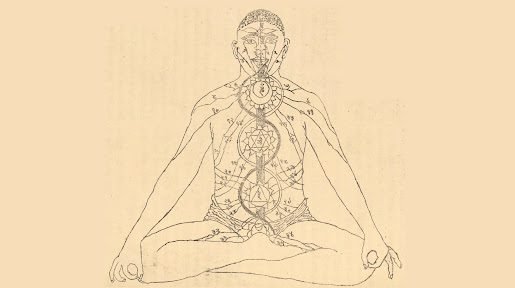
A randomised controlled trial published in 2025 found that an 11-minute online Yoga Nidra session produced measurable reductions in salivary cortisol — the primary stress hormone — compared to controls. A separate PET imaging study documented a 65% increase in dopamine release in the ventral striatum during Yoga Nidra — the brain's own reward and motivation system, activated without any external substance. A 2022 study found that during Yoga Nidra, some brain regions literally enter a sleep state while others remain conscious — a "local sleep" phenomenon not observed in ordinary meditation or ordinary sleep. It is a genuinely novel brain state.
Your brain produces its own restoration chemistry during Yoga Nidra. Cortisol down. Dopamine up. The physiological machinery of both stress recovery and motivation — reset in under 25 minutes, while lying on your living room floor.
Huberman Put a Lab Coat on It. That's Fine.
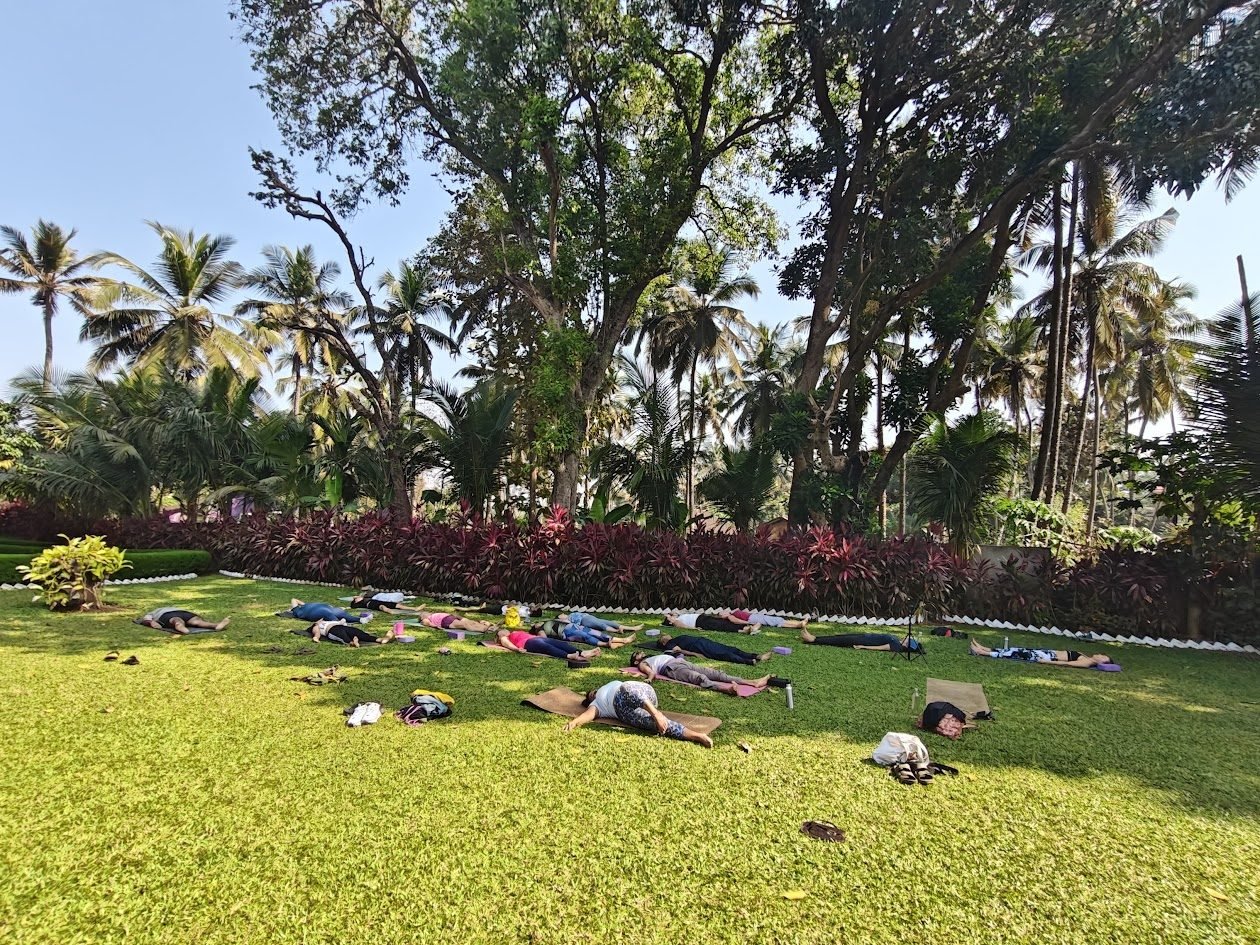
Andrew Huberman — neuroscientist, Stanford professor, podcast host with the most-listened-to health show on the planet — renamed Yoga Nidra "Non-Sleep Deep Rest" (NSDR). He did this, by his own admission, because the word "yoga" caused certain audiences to switch off. NSDR sounded clinical. It reached people who'd have ignored anything with Sanskrit in the name.
I have no argument with this. If rebranding ancient knowledge gets more humans to actually rest properly, I'm for it. My Art of Living training did not include a clause about protecting Sanskrit terminology from neuroscientists.
What I will say: almost every study Huberman cites for NSDR was conducted on Yoga Nidra practitioners. The physiology is identical. The dopamine surge, the cortisol reduction, the local sleep phenomenon — all Yoga Nidra research, wearing a new name badge. This doesn't diminish Huberman's contribution. It does mean that the practice he's recommending has 2,000 years of refinement behind it, not just a decade of lab studies.
Swami Satyananda Saraswati systematised modern Yoga Nidra in the 1960s at the Bihar School of Yoga, drawing on Nyasa practices from the Tantras. Dr. Richard Miller later adapted it into iRest — a clinical protocol validated for PTSD and now used by the US Department of Veterans Affairs. The continuum from ancient tantric practice to a Stanford neuroscientist's podcast is, I find, deeply satisfying.
For a precise, side-by-side breakdown of what Yoga Nidra and NSDR actually share and where they differ, I've covered it in full in this comparison piece. It is, if I may say, thorough.
"Wait — so this is science? Why didn't you just say it was science? You kept calling it yogic sleep and I thought you were selling me something."
Sankalpa: The Subconscious Science That Makes This Extraordinary
This is the part most introductions to Yoga Nidra rush past. They shouldn't.
Sankalpa (Sanskrit: संकल्प) means "an intention born from the heart's deepest knowing." Not a goal. Not a resolution. An intention — short, present-tense, emotionally alive. "I am at peace." "I trust myself." "My body heals." The distinction matters: a goal lives in the future. A Sankalpa lives in the present, as if the thing is already true.
Why Timing Is Everything
You could repeat an intention 100 times during an ordinary Tuesday. Your conscious mind will nod politely and then continue doing exactly what it was doing. The prefrontal cortex — your rational, evaluating, occasionally exhausting inner critic — will assess the claim and find it unsubstantiated. "I am at peace" delivered to a stressed prefrontal cortex is met with: "We have 47 unread emails. Are we at peace though?"
The hypnagogic state is different. At the theta border, the prefrontal cortex is no longer running full security. The critical filter relaxes. The brain becomes what neurologists call highly suggestible — not in a manipulative sense, but in the sense of being genuinely open. Intentions reach deeper encoding. They bypass the layer of habitual resistance and land somewhere that actually influences behaviour.
A peer-reviewed paper published in Healthcare (MDPI, 2025) on "Unlocking the Power of Sankalpa in Yoga Nidra" describes Sankalpa as "analogous to positive self-instructions used to counteract dysfunctional cognition." It notes that when intentions are formed during states of heightened receptivity — specifically the regulated, low-arousal state of Yoga Nidra — they are "processed with clarity rather than emotional volatility" and may initiate change within the subconscious mind through cognitive restructuring mechanisms. The study specifically highlights its potential for athletes and high-performers as a mental training protocol.
Sankalpa isn't positive thinking. It is an intention delivered at the precise neurological moment when the brain's resistance to change is lowest. This is the difference between shouting at a locked door and waiting until someone opens it.
My student Sunita started practising Yoga Nidra specifically for sleep. Her Sankalpa was simple: "I sleep deeply and wake with energy." Within three weeks, she reported something she hadn't expected — she'd stopped catastrophising before bed. The intention had done something beyond sleep. It had rewritten a pattern. This is consistent with what the research suggests: Sankalpa doesn't just aim at a symptom. It works at the level of the samskara — the deep habitual groove in the nervous system that keeps you running the same patterns on repeat.
If this connects to how you're managing anxiety — and for many people, the two are inseparable — the body scan and breath work in Yoga Nidra also directly target the overthinking patterns covered in this piece on meditation for severe anxiety.
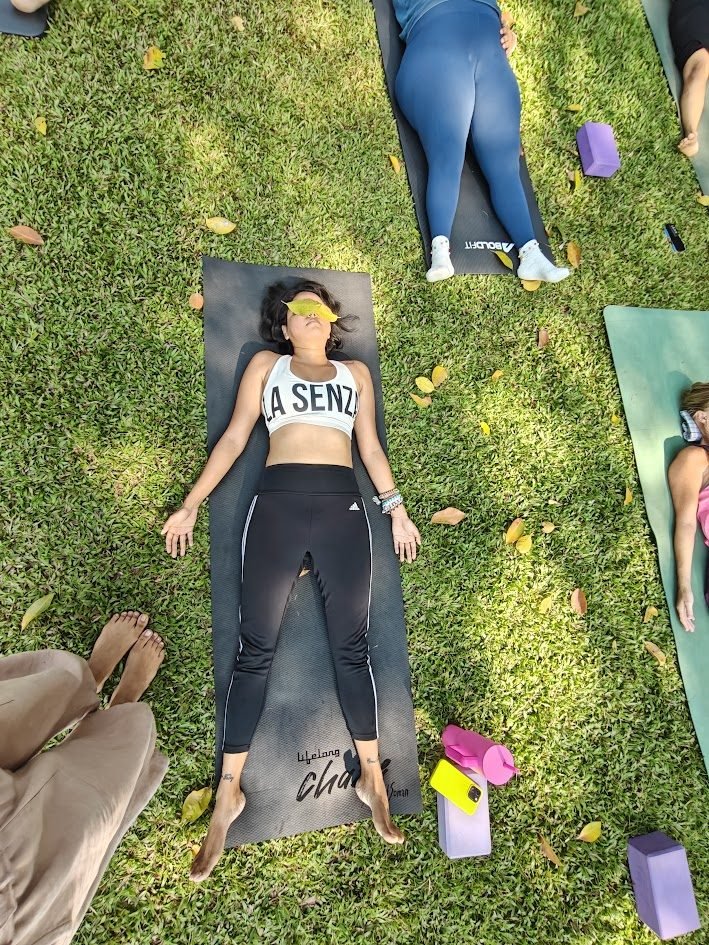
Tito's Journey (A Love Story in Three Acts)
Tito is the COO of Landocs. He runs operations for a company. He respects data. He is deeply, constitutionally suspicious of anything that involves lying on the floor while someone talks about "pairs of opposites." He thinks Lululemon leggings are evidence of civilisational decline. He once told a friend, with complete sincerity, that meditation was "just sitting with your thoughts, and your thoughts are usually not worth sitting with."
Act One: I ask Tito to try Yoga Nidra. He agrees, on the condition that I don't describe it using any Sanskrit words. I describe it as "a 20-minute guided rest protocol with documented cortisol benefits." He lies down. He is asleep within six minutes. I don't tell him that's not quite the goal.
Act Two: He tries again. This time he stays at the edge — that peculiar threshold where you're aware of the voice but your body has gone somewhere else entirely. He gets up and says, with genuine bewilderment: "Did twenty minutes just happen? That felt like five." Yes, Tito. That's the theta state. Time perception changes at the border of sleep. He says nothing for a moment. Then: "Do it again."
Act Three: He now does Yoga Nidra every Sunday. He does not fully understand it. He has stopped requiring that he understand it. He describes it to his colleagues as "the best 20 minutes of the week" and then refuses to explain further because, in his words, "it sounds insane to explain."
"I don't know how it works. I know that it works. Those are actually two separate things and both can be true simultaneously. I learnt that from the Yoga Nidra, I think."
This is, genuinely, the best testimonial I have ever received. I'm having it framed.
How to Start Tonight
The barrier is remarkably low. You need 20 minutes, a flat surface, and something to cover your eyes. That's it.
- Time: Afternoon is ideal — between 2 and 5pm, when cortisol naturally dips and the body craves rest. It is also effective before sleep. Avoid immediately after a large meal (digestion competes with the theta descent).
- Position: Flat on your back. Legs slightly apart. Arms away from the body, palms up. A blanket. A pillow under the knees if your lower back needs it.
- Your Sankalpa: Choose it before you begin. Keep it short — six words or fewer. Present tense. Something that genuinely moves you, not something that sounds appropriately aspirational. "I am enough" lands differently than "I will achieve my goals."
- Guided audio: Use it, especially at the start. The voice is the anchor. Without it, the ADHD-adjacent mind will plan dinner by the third minute. Good recordings are on Insight Timer and YouTube. The Bihar School of Yoga has the original versions — worth trying at least once.
- Duration: 20 minutes is the sweet spot. Research suggests this is sufficient for measurable cortisol reduction and the theta-state dopamine response. Even 11 minutes showed results in the 2025 RCT.
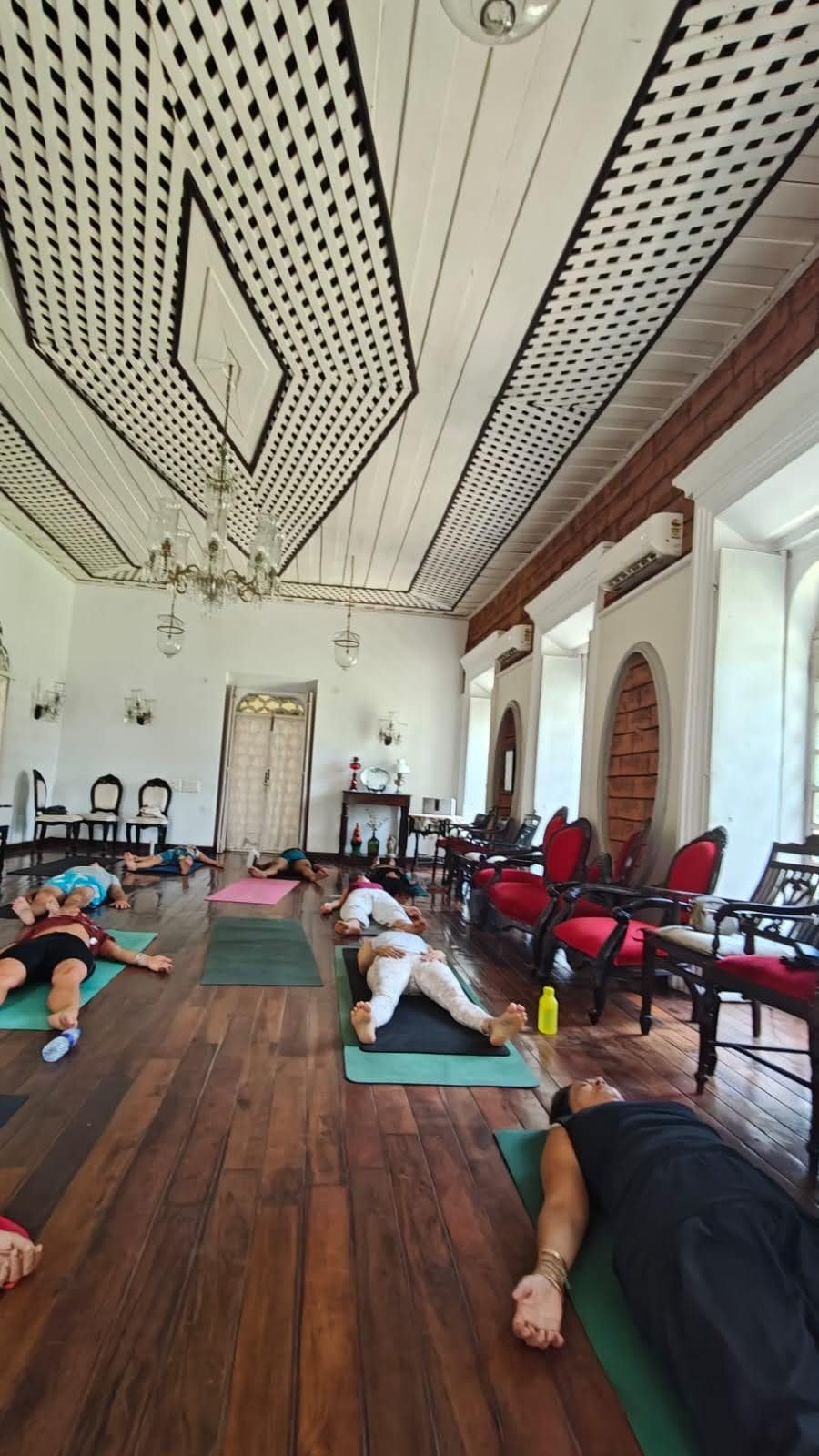
If you want to go deeper than audio — to learn the practice properly, to develop a personal Sankalpa with guidance, and to experience what it feels like in a room full of other people all letting go simultaneously — join a Yoga Nidra class at La Waha. We run sessions at Silva Heritage, in the ballroom with the Portuguese tiles and the chandelier that I always mean to photograph properly. It is a very good room for going inward. DM me on @varuna.shunglu and I'll tell you when the next one is.
If your primary goal is sleep — if the anxiety and the racing mind are what keep you up — we have a structured deep sleep programme built specifically around Yoga Nidra practice, done from wherever you are. It is not Goa. But it is the closest thing we've been able to build.
One in three adults globally doesn't get enough sleep. That is approximately 2.6 billion people — more than the combined populations of China and the United States, both, together, still exhausted. The global economic cost of that sleep deprivation: $411 billion annually in the US alone. Yoga Nidra costs nothing. This statistical disproportion should bother more people than it does.
The Classical Text That Got There First
"Svapna-nidrā-jñānālambanaṃ vā"
— Yoga Sutras of Patanjali, 1.38
Casual translation: Or, meditate by taking as your object the knowledge that comes from dreams and from dreamless sleep.
Patanjali, writing somewhere between 400 BCE and 400 CE — the scholarly consensus is impressively vague — identified the sleep-adjacent states as legitimate objects of meditation. Not something to escape. Something to move toward deliberately. He was describing, with characteristic economy, exactly what Yoga Nidra practitioners do: use the threshold of sleep as the practice itself.
He didn't call it NSDR. He had the Sutras. Same destination.
What I find remarkable — and what never fails to stop Tito mid-scepticism when I mention it — is that this sutra sits in the same text as instructions for achieving samadhi, the deepest states of meditative absorption. Patanjali wasn't being casual about sleep. He was pointing at the hypnagogic state as a doorway. Every fMRI study run since 2002 has confirmed that the doorway is real.
Goa is a state of nervous system, not a location. Tito still can't explain how Yoga Nidra works. He also cleared his Sunday calendar for it. I'll take that as the review.
Frequently Asked Questions
Is it okay if I fall asleep during Yoga Nidra?
It's common, especially at the start. The practice trains you to stay at the threshold — conscious but deeply relaxed — and this requires calibration. If you fall asleep, you still get rest. You don't get the full cognitive benefits of the theta-state awareness or the Sankalpa encoding. With regular practice, most people stop falling asleep within a few sessions. If you keep falling asleep, try sitting slightly propped rather than fully flat, or practice earlier in the day when sleep pressure is lower.
How is Yoga Nidra different from a nap?
A nap involves actual sleep — you lose consciousness, the brain cycles through sleep stages involuntarily, and you often experience sleep inertia (grogginess) upon waking. Yoga Nidra keeps you at the threshold of sleep while maintaining a thread of awareness. You wake feeling alert, not groggy. The dopamine restoration and cortisol reduction documented in research happen specifically at this conscious threshold, not during full sleep.
What should my Sankalpa be?
Present tense. Six words or fewer. Something that genuinely moves you emotionally — not something that sounds correct. "I am calm and clear" works if you feel something when you say it. "I will reduce my cortisol levels" does not work — it's future-tense, clinical, and emotionally inert. Common effective Sankalpas: "I trust myself," "I am healthy and whole," "I rest deeply and wake restored." Choose one and stay with it for at least 40 sessions before considering a change. Consistency allows it to deepen.
Can beginners do Yoga Nidra or is it advanced?
Yoga Nidra is one of the most accessible practices in the entire yoga tradition. There are no poses, no flexibility requirements, no prior experience needed. You lie down and follow a voice. The 2025 RCT showing cortisol reduction used participants with no prior meditation experience. If anything, it is easier for beginners than seated meditation — there is nothing to "do right" except stay gently awake.
How often should I practise Yoga Nidra?
Huberman recommends 10–20 minutes, one to three times per day for active recovery and performance. For general wellbeing and Sankalpa work, four to five sessions per week is sufficient for measurable changes. Daily practice for 40 days is the traditional recommendation for Sankalpa work — long enough for new neural patterns to begin consolidating. Even twice weekly produces benefit; it is infinitely better than none.