My mom put me in yoga at age four. Not because she was spiritual. Because I was, in her words, "a complete menace." I couldn't sit still at dinner. I rearranged the living room furniture twice in one afternoon. So she handed me to a yoga teacher in Alipore and said, "please." My teacher's first instruction: "Just breathe." I lasted about eight seconds before I started narrating the shapes of the clouds outside.
Nothing about me has fundamentally changed.
Read on for 5 ADHD-specific meditation techniques that actually work — I've tested all of them, and one has completely changed my mornings.
In this article
Why Traditional Meditation Fails ADHD Brains
Here's the standard meditation instruction: sit quietly, close your eyes, focus on your breath. Don't think about anything.
For an ADHD brain, this is basically a dare.
Traditional meditation was designed for neurotypical brains. Those brains can sustain focus on something boring. ADHD brains are wired differently. They need novelty and stimulation to function. Asking an ADHD brain to focus on "just breathing" is like asking a shark to float politely. It's not laziness. It's neurobiology.
The problem isn't that you can't meditate. The problem is you've been handed the wrong tool.
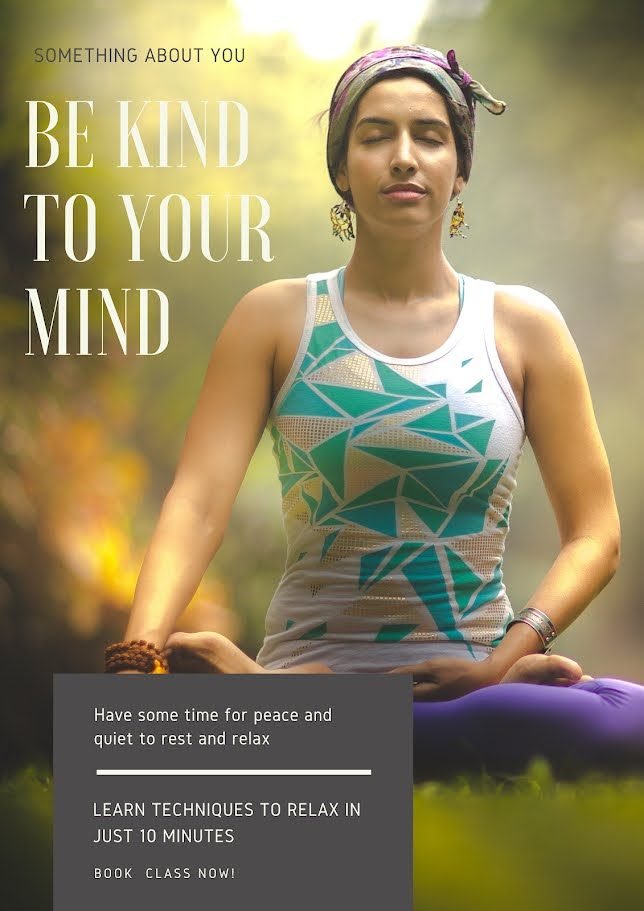
What's Actually Happening in Your ADHD Brain
Let's get into the science. Properly, not the "just be present" version.
ADHD is fundamentally a dopamine and norepinephrine problem. Your brain doesn't produce or regulate these neurotransmitters efficiently. Dopamine is the chemical that powers motivation, focus, and reward. Without enough of it, your brain can't prioritise or sustain attention. It goes channel-surfing instead.
In ADHD brains, the prefrontal cortex (PFC) — the brain's CEO, responsible for planning, impulse control, and attention — has reduced activity and connectivity. It can't coordinate properly with other networks. The result is increased internal "noise" and a brain that jumps from one thing to the next, looking for anything more stimulating than the current moment.
Your ADHD isn't a character flaw. Your PFC is literally under-resourced. And the brain keeps seeking dopamine hits because it's running on a deficit.
Here's where it gets genuinely exciting. A UCLA study found that 8 weeks of mindfulness practice significantly improved focus and reduced anxiety — in adults with ADHD. Not over years. Eight weeks. A Harvard study by Sara Lazar showed meditation physically increases cortical thickness in the PFC. Thicker PFC means better self-regulation.
And the dopamine piece: PET scan studies show that certain meditative states trigger a 65% increase in dopamine release in the brain's reward centre. That's enormous. That's the same pathway your brain is desperately looking for at 2pm when you've opened Instagram for the fourteenth time.
Meditation can give your ADHD brain the dopamine it's craving — without the doom-scrolling.
An estimated 366 million adults globally have ADHD. That's roughly the entire population of the United States and Canada combined — all trying to finish one thought before the next one interrupts it.

The Tamasha Problem: Your Brain Isn't Broken
Remember the film Tamasha? Ranbir Kapoor plays a man whose restless, non-linear brain doesn't fit into any conventional structure. He's not deficient. He's just running a different operating system than the world expects of him.
That's the ADHD brain. It's not that you can't focus. You hyperfocus on things that genuinely excite you. You just can't focus on command. The standard meditation instruction — "focus on nothing" — is like telling a Ranbir Kapoor character to deliver a PowerPoint presentation in Times New Roman. It's technically possible. It's also going to be a disaster.
The fix isn't to force neurotypical meditation onto an ADHD brain. The fix is to find the version that works with your brain's wiring.
What Reddit Actually Says (And It's Honest)
I spent time reading ADHD and meditation threads online. The dominant perspective: "Every time I try to meditate, I end up planning my entire week inside my head and then feeling guilty about it."
Relatable. The guilt is the worst part. You sit down to meditate and end up reorganising your mental filing cabinet and then spiralling about the fact that you just "failed" meditation. Again.
The second most common thread: "Guided meditation is the only thing that works — the voice gives my brain something to track."
This is neuroscience, not preference. The ADHD brain needs an external anchor — a voice, a sound, a sensation — to stay present. Without one, it goes off to write a grocery list or compose an imaginary argument it will never have.
5 Meditation Techniques That Actually Work for ADHD
I've tested all of these personally. Some work better than others depending on the day, the season, how much coffee Tito has made, and whether I slept well. Start with one.
Walking Meditation (Movement as the Anchor)
This is my personal favourite. Walk slowly and deliberately — on the beach, around a room, anywhere. Feel each footfall. Notice the ground. Count your steps up to ten, then start again. The movement provides the dopamine input your brain needs. Your attention has a physical object to track. No sitting required. I do this barefoot on the beach at Benaulim most mornings. On the days I skip it, everyone notices.
The Physiological Sigh (30 Seconds, No Excuses)
This is the one Huberman's lab at Stanford has researched extensively. Double inhale through the nose — a short sharp breath, then a second top-up — followed by a long, slow exhale through the mouth. Do this twice. It directly stimulates the vagus nerve. Your heart rate drops. The nervous system shifts into parasympathetic gear in under a minute. For ADHD brains, it's the fastest reset I've found. I use it between meetings, before classes, and whenever Tito says "we need to talk about the credit card bill."
Guided Audio (Give Your Brain a Voice to Follow)
Unguided silence is brutal for ADHD. Guided meditation gives the brain a job — tracking the voice — so it doesn't wander off to rewrite old conversations. Use a good guided session of 10–15 minutes. Apps like Insight Timer work. Yoga Nidra recordings are especially effective because they move through systematic body attention, which satisfies the ADHD brain's need for novelty and structure simultaneously. If you want to try a structured guided practice, the La Waha deep sleep programme includes sessions specifically designed for restless minds.
Yoga Nidra (Lying Down Counts)
You lie flat. You close your eyes. A teacher's voice guides your attention through your body, one part at a time. The rotation of consciousness gives the ADHD brain a continuous sequence to follow — there's always a next instruction coming. You can't space out for long because the next body part is already being named. It's the most effortless meditation format I've found for restless minds. A 20-minute session produces measurable parasympathetic recovery. That 65% dopamine surge I mentioned? It was documented during Yoga Nidra specifically.
Micro-Meditations (1–3 Minutes, Stacked Into Your Day)
You don't need a dedicated 20-minute session. ADHD brains do better with multiple short resets than one long attempt. Stack a 90-second breath awareness onto your existing habits — while the chai is brewing, before you open your laptop, at every red light. Research shows even brief, repeated mindfulness moments shift baseline nervous system tone over time. My student Advaith does 90 seconds of breath awareness before every meal. He says it's the only meditation he'll actually do. That's fine. That counts.
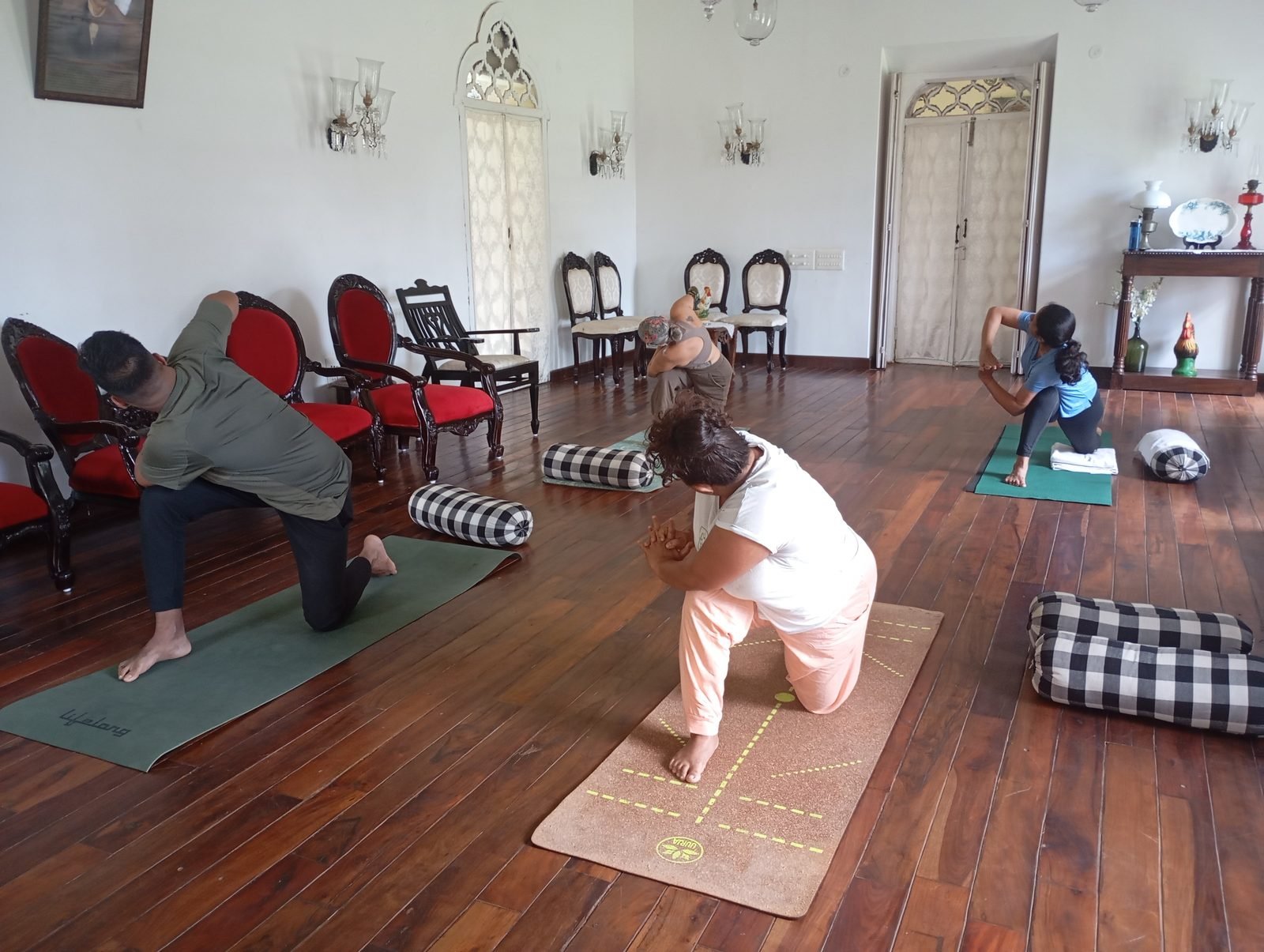
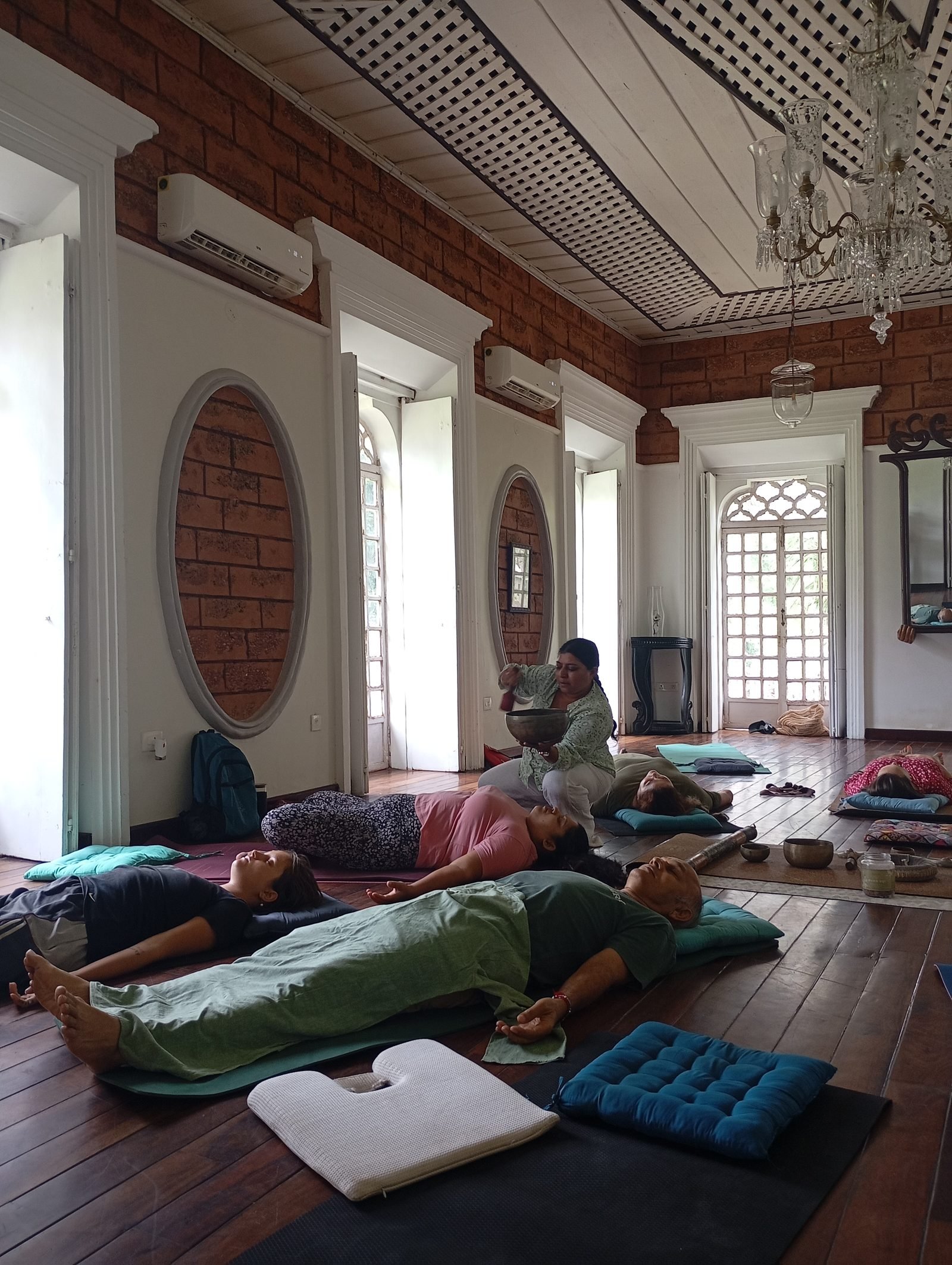
The Yoga Sutra Written for You
"Abhyāsa vairāgyābhyāṃ tan nirodhaḥ"
— Yoga Sutras of Patanjali, 1.12
Casual translation: The mind is stilled through practice and non-attachment.
Patanjali didn't say "by sitting perfectly still and emptying your mind." He said practice and non-attachment. The practice part is obvious — you have to show up. The non-attachment part is the ADHD gift. Non-attachment means releasing the expectation that every session will feel profound. Some sessions will feel like a dog chasing its own tail. That's still practice. Patanjali is fine with this.
My Dad — who is a lawyer and a yoga teacher, which means he is technically undefeatable in any argument — told me once: "The mind that resists practice is the mind that most needs it." He was talking to me specifically. I was seventeen and had just skipped my morning sit to watch television. Some things don't change.

The goal isn't to fix your ADHD brain. The goal is to work with it. Short, anchored, movement-friendly, guided — these aren't compromises. They're the actual practice. The yoga tribe's insistence that real meditation means forty-five minutes of motionless silence is just gatekeeping dressed in linen.
If you want to explore this with actual support, join regular classes at La Waha with me, Rohit, or Elaine at Silva Heritage — we run hybrid sessions for all kinds of brains. Or DM me on Instagram @varuna.shunglu with questions. I answer, I promise. Sometimes within the same day.
Start tomorrow morning. Before you check your phone. One physiological sigh. Twice. That's it. See what happens.
Frequently Asked Questions
Can people with ADHD actually learn to meditate?
Yes — but not with the same approach designed for neurotypical brains. ADHD brains need anchors (a voice, movement, or sensation), shorter sessions, and more novelty. Guided meditation, walking meditation, and Yoga Nidra consistently work better than silent seated practice for most people with ADHD.
How long should I meditate if I have ADHD?
Start with 3–5 minutes. Research supports multiple short sessions over one long impossible one. The physiological sigh takes under 90 seconds and produces measurable nervous system effects. Build duration gradually — most ADHD practitioners find a sweet spot at 10–15 minutes with guidance.
Does meditation replace ADHD medication?
No. Meditation is a complementary practice, not a replacement for prescribed treatment. Studies show it improves attention, emotional regulation, and working memory as an adjunct to other care — not as a standalone cure. Always work with your doctor on medication decisions.
What is the best type of meditation for ADHD?
The one you'll actually do. That said, Yoga Nidra and guided body-scan meditations consistently show the strongest results for ADHD adults in research because they provide continuous cognitive anchoring. Walking meditation is excellent for those who find lying still difficult. The physiological sigh is the fastest-acting technique for acute restlessness.
Why does meditation feel harder with ADHD than for other people?
Because the ADHD prefrontal cortex has reduced connectivity and lower dopamine availability. Silent, unguided meditation provides zero dopamine input — the brain immediately seeks stimulation elsewhere. This is neurological, not a lack of willpower. Choosing the right format removes the structural barrier entirely.